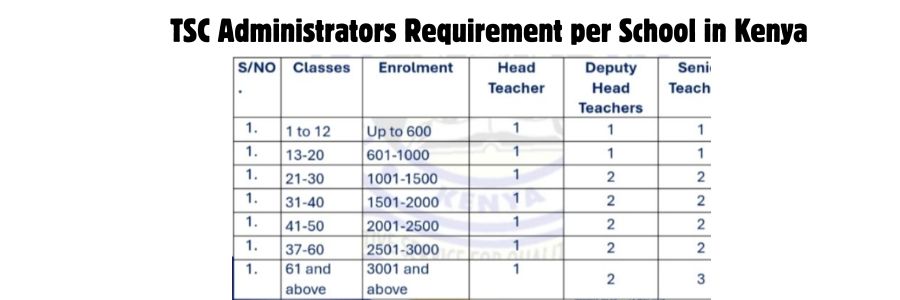
The Teachers Service Commission (TSC) has issues guidelines to help schools understand the minimum number of administrators and senior teachers required to ensure smooth management and effective learning.
These requirements provide important clarity to TSC staffing guidelines for primary schools,
TSC Senior Teacher Requirement for Primary Schools
According to the TSC staffing structure:
- Every class should have one teacher assigned per class.
- Each school should also have one additional teacher for support and administration.
- Schools with enrolment exceeding 1,000 learners are required to have a second deputy headteacher.
Primary School Staffing Structure by Enrolment
Schools with 1–12 Classes (Up to 600 Learners)
Schools with smaller enrolment are required to have:
- 1 Headteacher
- 1 Deputy Headteacher
- 1 Senior Teacher
These are mostly small and medium-sized primary schools.
Schools with 13–20 Classes (601–1000 Learners)
Schools within this category should have:
- 1 Headteacher
- 1 Deputy Headteacher
- 1 Senior Teacher
Despite the increase in enrolment, the administrative structure remains the same until the school surpasses 1,000 learners.
Schools with 21–30 Classes (1001–1500 Learners)
Once enrolment exceeds 1,000 learners:
- 1 Headteacher
- 2 Deputy Headteachers
- 2 Senior Teachers
This adjustment helps manage the growing student population and academic activities.
Schools with 31–40 Classes (1501–2000 Learners)
These schools are required to have:
- 1 Headteacher
- 2 Deputy Headteachers
- 2 Senior Teachers
The additional administrative support improves supervision and curriculum implementation.
Schools with 41–50 Classes (2001–2500 Learners)
The staffing requirement includes:
- 1 Headteacher
- 2 Deputy Headteachers
- 2 Senior Teachers
Large schools require stronger leadership structures to manage operations effectively.
Schools with 51–60 Classes (2501–3000 Learners)
For schools in this category:
- 1 Headteacher
- 2 Deputy Headteachers
- 2 Senior Teachers
The staffing pattern remains consistent for schools with large enrolment numbers.
Schools with 61 Classes and Above (3001 Learners and Above)
Very large primary schools should have:
- 1 Headteacher
- 2 Deputy Headteachers
- 3 Senior Teachers
The increase in senior teachers helps coordinate academics, discipline, and school programs more effectively.
Why the TSC Staffing Guidelines Matter
The TSC staffing formula is important because it:
- Helps balance teacher distribution across schools
- Improves school administration
- Enhances learner supervision
- Reduces teacher workload
- Supports quality education delivery
Schools that do not meet these staffing thresholds often face challenges such as overcrowded classrooms, teacher burnout, and administrative pressure.
Conclusion
The latest TSC teacher requirement per school in Kenya provides a clear staffing framework for primary schools based on enrolment and number of classes. As enrolment continues to grow in many public schools, proper staffing remains critical for maintaining education standards and improving learner outcomes.
School boards, teachers, and parents should stay updated with TSC staffing policies to better understand how schools are managed and staffed across the country.

Betty is a qualified teacher with a Bachelor of Education (Arts). In addition, she is a registered Certified Public Accountant. She has been teaching and offering part-time accounting services for the last 10 years. She is passionate about education, accounting, writing, and traveling.